Overthinking & rumination
How the mind can replay the past, predict the future, and keep an emotionally unresolved loop open.
AUTHOR · SYSTEM BUILDER · OBSERVER OF HUMAN PATTERNS
Author of Insight and creator of the Forcesmith Mental System.
My work applies systems thinking, engineering logic, programming-style debugging, and long-term self-observation to one question:
Why do we keep reacting in ways we already know are not helping us?
Not a clinical method. Not a motivational slogan. A map for seeing more clearly.

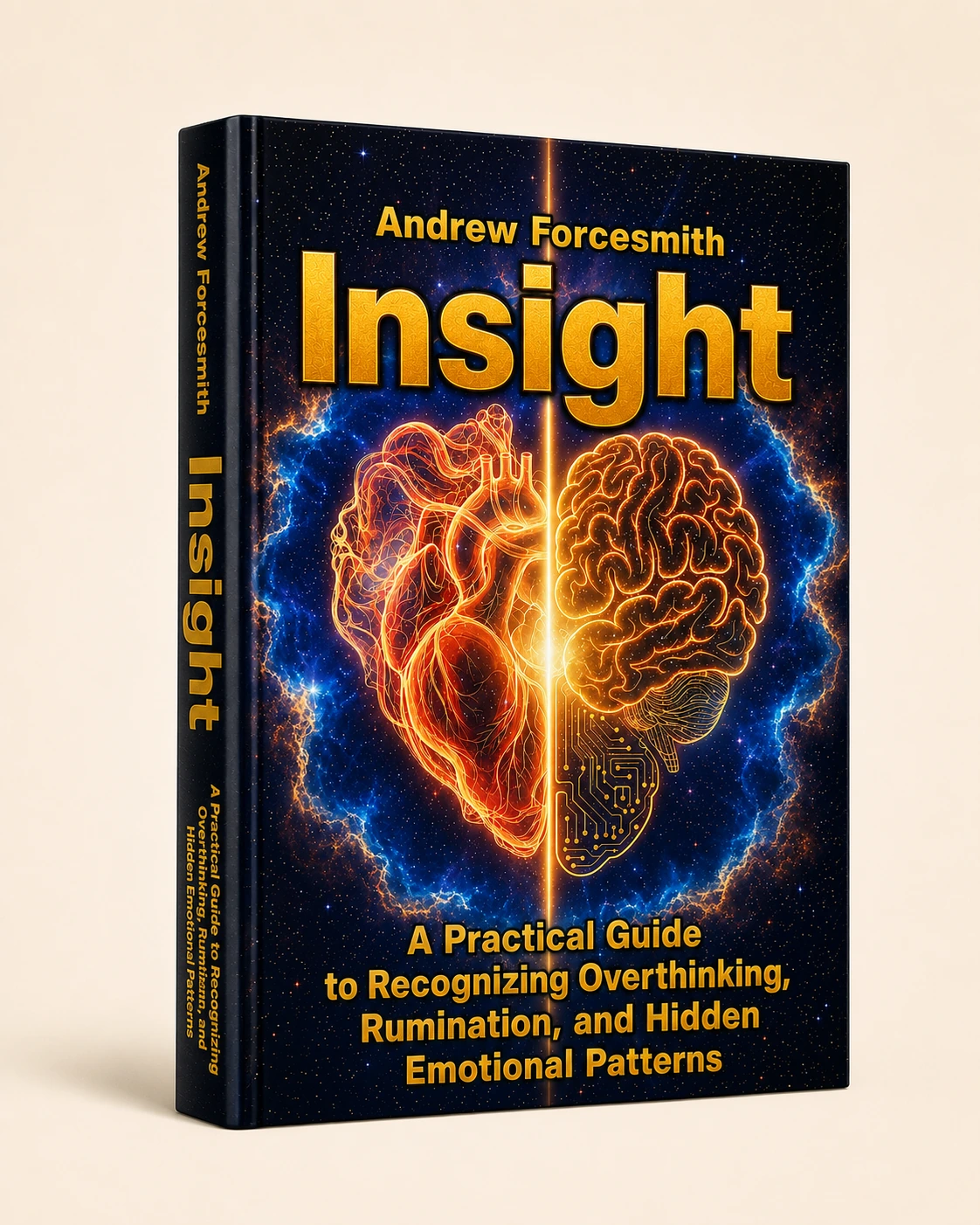
THE INTRODUCTORY BOOK
The Forcesmith Mental System: Insight
A Practical Guide to Recognizing Overthinking, Rumination, and Hidden Emotional Patterns
Insight is not a promise of a quick fix. It is the first structured entrance into the Forcesmith Mental System: an inner map for recognizing what may sit behind recurring thoughts, emotional pressure, automatic reactions, and repeated relationship patterns.
It is written for readers who have already heard advice such as “think positive,” “communicate better,” “set boundaries,” or “just let go” — but still want to understand why the same internal process keeps starting again.
“The goal is not to believe everything immediately. The goal is to see more clearly.”
WHAT INSIGHT EXPLORES
Overthinking and rumination may be what you notice first. The deeper question is what keeps activating them — uncertainty, an unresolved situation, a threatened inner self-evaluation, or a hidden emotional pattern.
How the mind can replay the past, predict the future, and keep an emotionally unresolved loop open.
Forcesmith concepts for observing the fast inner evaluation and response processes behind many automatic reactions.
How old fears, wounds, expectations, self-identifications, and unresolved pressure can become silent activators.
How a person may gradually adapt to a worsening mental, relational, or environmental state without recognizing the full change early enough.
ABOUT ANDREW
Andrew Forcesmith began actively studying self-development through direct experience and self-observation in 2004. Around 2006 he began writing down the elements of the mental model that would later become the Forcesmith Mental System.
His working method was never to accept an idea simply because it sounded convincing. He observed it, tested it against experience, refined it, and returned repeatedly to the question of where the model might be wrong.
The first version of his book was completed in 2016. The renewed English edition, The Forcesmith Mental System: Insight, develops that earlier work into a more structured introduction to Self-Sense, Ego Reflex, overthinking, rumination, hidden emotional patterns, and the Mental Boiling Frog Effect.
THE APPROACH
When a technical system produces the same error again and again, a programmer does not merely tell the output to behave differently. The process is traced backward until the source of the error becomes visible.
Describe what is happening before deciding what it means.
Connect situation, inner state, reaction, behavior, and consequence.
A useful model must remain open to correction when reality does not fit it.
Understanding matters when it helps you respond more consciously in real situations.

THE FORCESMITH MENTAL SYSTEM
The Forcesmith Mental System is a systems-based framework for understanding how subconscious emotional patterns, automatic reactions, conscious thought, and human interaction influence one another over time.
It looks at behavior as a dynamic action–reaction process rather than a collection of isolated symptoms. The aim is to make recurring patterns observable enough that a person can begin to understand where a process starts, what keeps it alive, and where conscious change may be possible.
Explore forcesmith.orgWHO THIS WORK IS FOR
You do not need to agree with every idea in advance. Curiosity, observation, and willingness to examine your own reactions are enough to begin.
People who want depth, structure, and a more precise way to understand recurring inner problems.
Especially when overthinking or rumination keeps returning despite surface-level techniques.
People who naturally look for mechanisms, patterns, feedback loops, and cause–effect relationships.
“Do not read this book only as information.
FOLLOW THE WORK